Where does Surface Physics sit in science, who uses it, and what does it draw on?
What is Surface Physics working on, and where is it strong? Each faint dot is a discipline, placed by how disciplines cite each other, so close disciplines share a literature. The map never moves, so entities can be compared by eye. A circle's area shows Surface Physics's publications in that discipline; its colour shows how often they reach the top 10% of the discipline and year, against the world's 10%. The disciplines citing it have a diversity score of 0.58, higher than 45% of topics. Those it cites have 0.53, higher than 38%. The index adds up pairs of disciplines, weighted by their shares and how far apart they sit on this map; its parts are debated, so read it with the map.
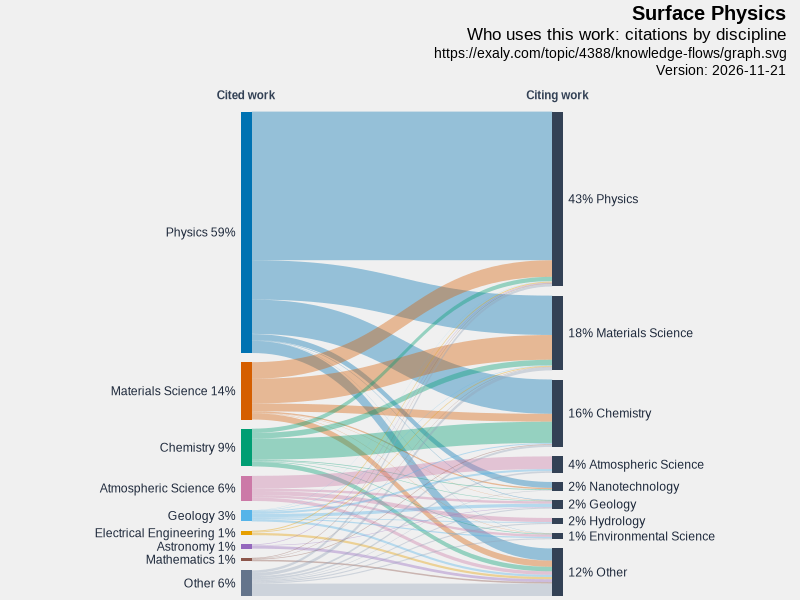
Who uses this work, and does it reach beyond its own community? Left: the disciplines of Surface Physics's publications. Right: the disciplines of the work citing them. A paper or citation in several disciplines is split equally among them. The eight largest are named on each side, and the rest are in Other. Journals with no discipline are shown as unclassified or multidisciplinary.